![JETZT [PR]](https://blogger.googleusercontent.com/img/a/AVvXsEima_UHr5DGjfRb6XGnD8vOhgkiChKVKjDzpEtAZtDj9_qg8hZsIrOIwitZWjdbccQB4sDVIXYOCPluxNuUvKegUQSNk0uszej9V2ebb6nN2dTiuYC-d0FpLXlG9ilrRnhBmZs2fnttJmkVBMntA3Lm_Eu0P3YpeFheQm0WtUBGQq6G74ttwm5314DFnQ=s1600)

How Laser Excited Acoustics is making automated inspection practical in aerospace, defense and MRO
Every aircraft that flies depends on parts that look perfect from the outside but may hide delaminations, disbonds or porosity within. Finding those defects is the job of non-destructive testing, and for decades it has meant slow, manual ultrasonic inspection. XARION Laser Acoustics is changing that. Its Laser Excited Acoustics (LEA) technology makes automated ultrasonic inspection practical across aerospace, automotive, defense and MRO, closing a gap that conventional methods never could.No Water, No Contact: A Technology Made for Automation
At the heart of XARION's inspection solutions is Laser Excited Acoustics (LEA), a dry and contact-free ultrasonic testing method that combines a pulsed laser for ultrasound generation with XARION's Optical Microphone for detection. In contrast to conventional ultrasonic testing, no probe must be pressed against the part, and no water or gel is required to transmit the ultrasound.
Because LEA operates without physical contact and without water coupling, it removes two of the main practical challenges associated with automating ultrasonic inspection. There is no need to maintain a controlled contact and coupling condition between sensor and component, and no need for water management infrastructure. This simplifies system integration and makes it easier to inspect components with complex geometries.
“You can imagine that for many of our customers, this is a real game-changer", says Dr. Balthasar Fischer, founder and CEO of XARION Laser Acoustics. "Because our technology works completely dry and without contact, it can be automated easily with robots, without any water to manage around the system. For a manufacturer, that means a cheaper integration and lower operating costs, and the freedom to inspect parts that were previously very difficult to handle.”
The result is an ultrasound inspection technology that is particularly well suited for applications where flexibility, automation and ease of deployment matter as much as inspection performance itself.
Proven in Aerospace Production
XARION's LEA technology is industrially used to inspect helicopter tail booms at a major European aerospace OEM (Figure 1). These large CFRP structures combine complex geometries with a mix of monolithic and honeycomb sections within the same component. The decisive factor in this application is accessibility: a key inspection challenge is reaching the internal regions of the tail boom. The compact, fiber-coupled LEA probe (Figure 2) can be mounted on a robotic lance and inserted into the structure, enabling automated inspection of areas deep inside the component, where the narrow internal space leaves little room. The contactless operation of LEA allows reliable automated inspection of these demanding aerospace structures.
The technology is already used in a wide range of additional industrial inspection applications across aerospace, automotive and other industries. LEA is suited to the inspection of composite materials, including CFRP and GFRP, and metallic components. It is equally applicable to complex structural configurations such as bonded assemblies and sandwich structures. This broad applicability allows manufacturers to address a diverse set of inspection tasks using a single technology platform.
The advantages of LEA are not limited to compact probe dimensions and improved accessibility. In many applications, the absence of water coupling is equally important. One example is the inspection of open aluminum honeycomb structures used as abrasive seals in jet engines. In such components, water-coupled inspection reaches its limits, because the water jet is scattered at the exposed honeycomb edges, preventing the acquisition of readable ultrasonic data. Since LEA operates without water coupling, it avoids this limitation and enables the inspection of structures that are difficult to assess with conventional ultrasound methods.
Another challenge faced by many customers is the need to inspect a wide variety of components within the same production environment. Different structures, materials and geometries often require specific inspection setups or approaches. "We work with customers who need to inspect many different honeycomb and monolithic structures, sometimes on the same day", says Fischer. "The fact that our technology handles a wide range of materials without any change in setup is not something they take for granted. It used to require completely different inspection approaches for each part." From large aerospace production systems to challenging small-scale honeycomb applications, LEA has already proven itself in demanding industrial environments.
Automation Beyond the Production Line: Closing the Gap
Conventional automated inspection systems are efficient at high volumes and stable geometries, but they are difficult to justify for small batches and frequently changing component types. Add a requirement for mobility, where the system must come to the part rather than the other way around, and most automated solutions are ruled out entirely. This is the automation gap: a large share of aerospace and defense inspection work falls precisely into this category and has therefore remained manual.
XARION's LEAbot is designed to close this gap (Figure 3). Mounted on a collaborative robot (cobot), the LEA sensor forms a compact and flexible inspection cell that is easy to operate. It can be moved directly to the component, whether a fuselage skin panel, a wing leading edge or a control surface assembly, and is ready to scan within minutes. There is no couplant, no surface preparation and no fixed infrastructure required, and the cell can be redeployed between part types within minutes.
"We see a lot of potential here", says Dr. Josef Pörnbacher, CTO of XARION Laser Acoustics. "Small series, changing part types, and the need to bring the inspection to the component are exactly the conditions where conventional automation does not pay off. Our mobile, dry and contactless system is a perfect match for these applications, in production as well as in maintenance, repair and overhaul."
This makes LEAbot well suited to small-scale production and to MRO across aerospace and defense. In MRO in particular, aircraft must be inspected at regular intervals throughout their service life, often across mixed fleets and repaired sections with modified geometries, conditions that match the strengths of a flexible, mobile system. By automating the scanning and analysis process, LEAbot also significantly reduces the manual effort involved: qualified personnel no longer inspect component after component by hand, but instead manage the system, review flagged indications and make the final determination. Inspection reports, scan data and defect localizations are generated automatically and reproducibly, which matters wherever inspections must be traceable.
Pulse-Echo LEA: The Perfect Solution for Aerospace Applications
LEA can be operated in several inspection modes, which makes it versatile across a wide range of applications and industries. Through-transmission requires access to both sides of a part at the same time. Pitch-catch works from a single side and is well suited for checking the bond between honeycomb cores and their skins, though it provides no depth information. Pulse-echo also operates from a single side, and it is the mode that makes the decisive difference: it tells the engineer exactly how deep they sit. In aerospace and defense, this single-sided capability matters most, because installed structures such as wing skins, fuselage panels, assembled modules and welded parts can only be reached from the outer surface.
The depth information from pulse-echo is what makes it so valuable in practice. In carbon fiber structures it directly determines the repair decision: a surface-adjacent delamination may be addressed by local patching, while a defect at a structural ply may require a more significant intervention or part replacement. "With pulse-echo, we get the full depth profile of the part from a single scan pass", explains Pörnbacher. "We can tell you not just that there is a delamination, but exactly which layer it is in. That is the information the engineer needs to make a repair decision, and it is something one-sided air-coupled systems simply have not been able to deliver before. They struggle here because the signal returning through air is extremely weak and overshadowed by transducer ringdown effects, but our Optical Microphone is sensitive enough to detect it reliably."
The pulse-echo probe on a LEAbot captures the full structure, and XARION's own LEAstudio software turns the data into clear visual results (Figures 4 and 5). Disbonds and delaminations become visible at a glance, including exactly where and how deep they are within the materials.
With its LEA solutions, XARION Laser Acoustics is closing the automation gap in ultrasonic testing and enabling practical, scalable, automated inspection solutions for aerospace, defense and MRO applications.
XARION Laser Acoustics GmbH will present its LEA inspection products at this year’s ILA Berlin (International Aerospace Exhibition) from June 10 to 14, in Hall A, Booth 261. The XARION team – Dr. Martin Wallner and Gregor Muthsam, MSc – will be available on-site for discussions and project-specific inquiries.
Author: DI Philipp Ziegler, Senior Application Engineer
--
Press pictures - high-res versions: Download
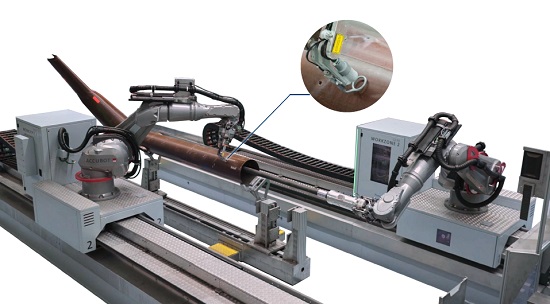
Figure 1 / Industrial LEA-based inspection system in production use for automated helicopter tailboom inspection. Inset: the laser-based ultrasound generation unit of the through-transmission inspection head.
(© XARION Laser Acoustics)
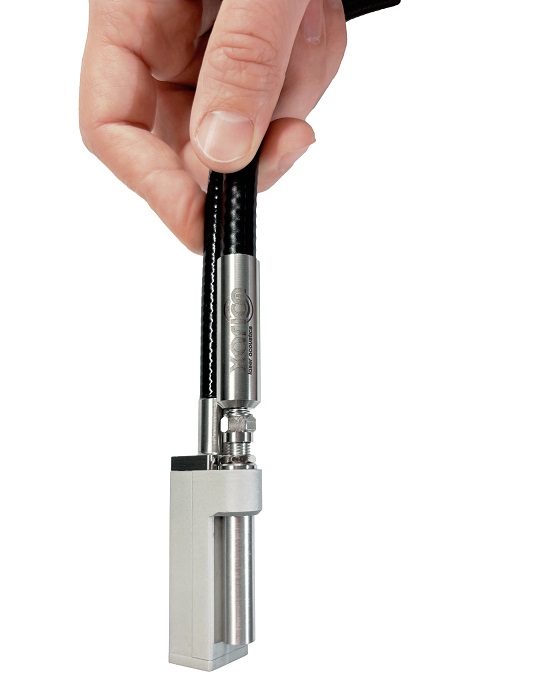
Figure 2 / This compact, fiber-coupled inspection head enables automated, single-sided testing in confined and hard-to-reach areas (hand shown for size reference). It creates ultrasound images of internal material defects (e.g., in aircraft wings) completely contact-free, without requiring coupling gel, using an eye-safe laser.
(© XARION Laser Acoustics)
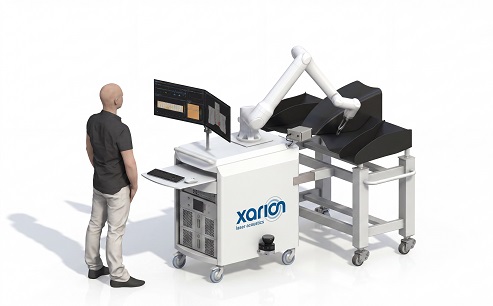
Figure 3 / LEAbot turnkey inspection system for the automated detection of hidden internal material defects. Without requiring physical contact or water coupling, this mobile cobot solution is uniquely suited for flexible, small-series industrial production and aircraft MRO.
(© XARION Laser Acoustics)
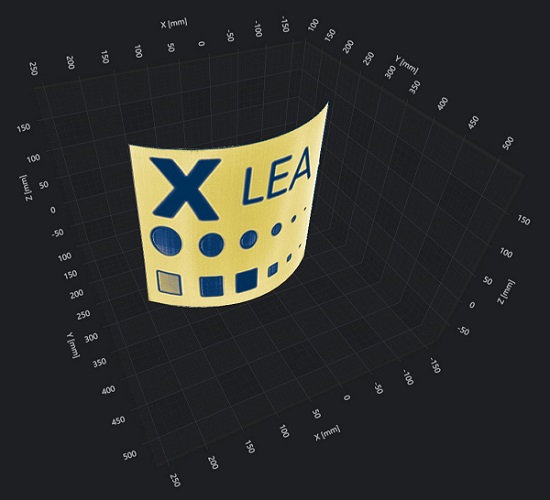
Figure 4 / XARION’s LEAstudio software is designed for a three-dimensional world. A 3D C-scan image (curved monolithic specimen) enables straightforward identification of defects on components of any shape.
(© XARION Laser Acoustics)
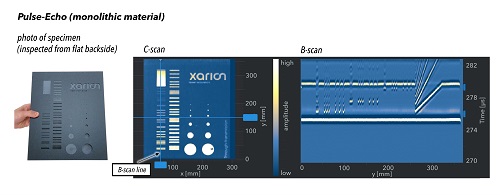
Figure 5 / Pulse-echo inspection of a monolithic structure with flat-bottom holes. From left to right: photo of the specimen (inspected from flat backside); C-scan inspection result clearly showing the location and size of the holes; B-scan showing the associated depth of the defects.
(© XARION Laser Acoustics)
--
Founded in 2012, XARION Laser Acoustics GmbH develops and manufactures innovative, laser-based acoustic sensors. Its patented Optical Microphone enables contactless ultrasonic inspection across a wide frequency range, ideal for high-resolution material testing and in-line process monitoring. XARION’s solutions serve industries where precision, reliability, and speed are critical, including aerospace, automotive, microelectronics, and battery manufacturing. With over 30 international patents and leading industrial partners, XARION is setting new standards in ultrasonic quality assurance.
Press contact:
XARION Laser Acoustics GmbH
Ghegastrasse 3
A – 1030 Wien
Mag. Eva Porodko
E-Mail: e.porodko@xarion.com
Phone: +43 1 907 60 76 0
https://xarion.com/
Kommentare
Kommentar veröffentlichen